At a workshop at Peggy’s Place, off to the right side of the courtyard in the shade, sat a Black woman. A mother.
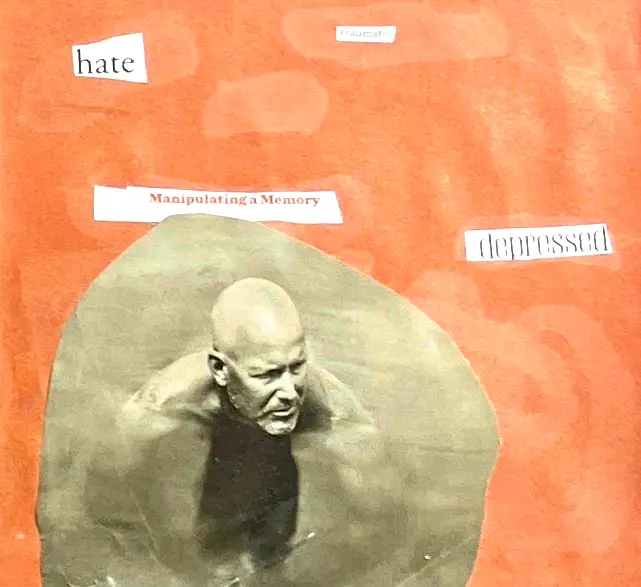
Separated from the rest of the group, she assembled her collage. In tears. Distraught.
She did not want to be unhoused.
She did not know how long she’d have to stay at the emergency shelter.
Clearly processing her situation in real time, the collage she made says it all.
I tried to comfort her. But really, all I could do was listen.
It was that moment that activated me. It sparked the question: what does trauma-informed care look like for me in practice?
What we mean when we say trauma-informed care?
Trauma-informed care (TIC) is not a specific intervention, like cough syrup.
In my mind, it looks more like Qigong — a series of intentional mind-body movements that create balance and nourish wellbeing. Within that frame, I’ve come to understand TIC as a series of relationship-driven behaviors embodied by practitioners to respond to, and reduce the effects of, traumatic stress on people.
Like Qigong, it is a skill developed through consistent practice.
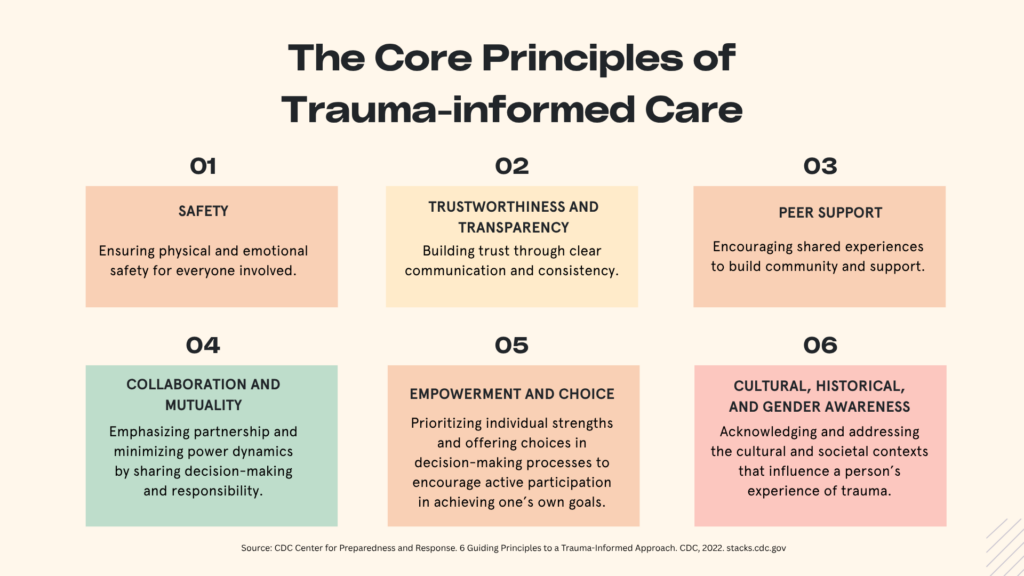
These principles are sound. But the order troubles me.
When we lead with safety before we’ve done the work of acknowledging cultural and historical context, we’re building on shallow ground. We’re asking people to feel safe inside systems that have never been safe for them — without naming that first.
So what if we switched them…
A tea party and a thought experiment
Let’s wrap ourselves in a warm blanket of “what if” questions where there are no bad ideas because we’re just playing.
Imagine.
A tea party.
Complete with make-believe sweets and tiny finger sandwiches. I’m drinking vanilla rooibos tea with steamed milk; you can have whatever you like.
Now — what if we took the building blocks of trauma-informed care and reconstructed them?
Not as an academic exercise, but grounded in a decade of practice as a professional facilitator, in the lessons Detroit has taught me, and in everything I’ve learned from sitting with people in their hardest moments.
Here is my creative approach to trauma-informed care:
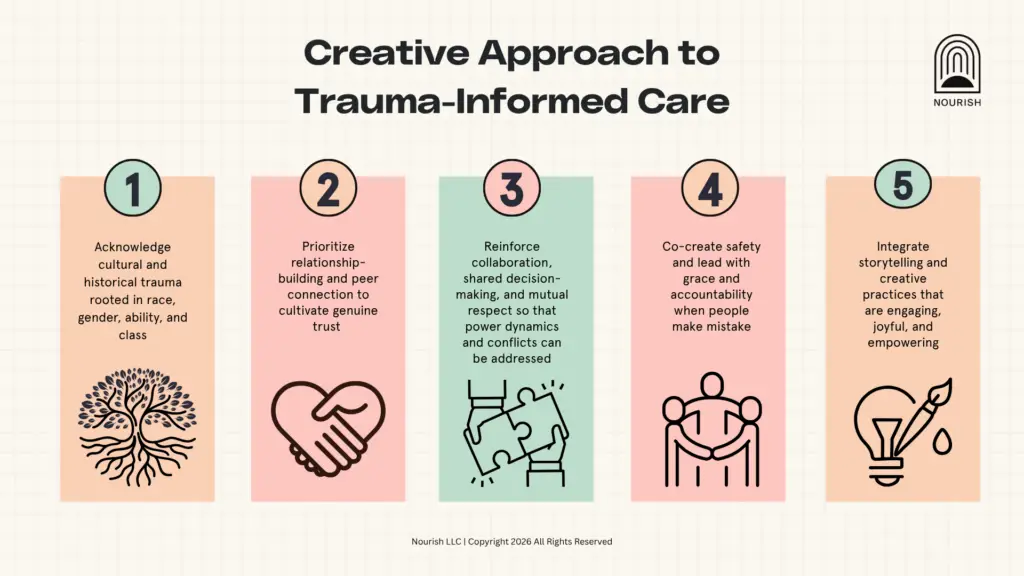
Why the change? Hear me out.
Start at the beginning
Because trauma-informed care orients from an understanding of how the past informs the present, one must ask: What happened to you?
To answer that honestly, we have to start at the beginning. Our stories told in the context of history, culture, and our personal lived experiences.
And by “we,” I mean the collective “we”: practitioners and clients. You, me, everybody.
Capitalism. Classism. Racism. Ableism. Sexism. These are the deep cultural waters we are all wading in. They determine who is worthy of care, what kind of care is offered, how it might be received, and what kind of traumas might be in the mix.
No one is immune to conditioning.
Providers bring their own beliefs, biases, and experiences. The patient brings the same.
That is why I believe trauma-informed care has to begin with an awareness of how history and culture shape us at its foundation.
But the good news is, TIC is a two-way street where care and healing flow in both directions.
Relationship before intervention. Always.
The reordering of the TIC principles is informed by my experience living in Detroit, a predominantly Black city with a history of innovation, revolutionary leadership, and community organizing.
Black and brown people here move different.
Co-design with community and the sharing of resources are cultural expectations.
Coming from Seattle, it was jarring at first.
But what Detroit taught me — what I had to learn — is this: before you try to intervene, get to know people. Be a humble student of their culture. Demonstrate you are someone they can rely on. Be real, with the appropriate professional boundaries.
Genuine relationships are at the center of trauma-informed care. It is a prerequisite for everything else.
Will there be mistakes? Sure.
Will there be conflict? Absolutely.
Sorting through relational power dynamics and resolving interpersonal conflicts are part of the healing process for practitioners and people on the other side.
Creativity is Medicine
“Art is healing because it enhances the quality of our lives.” — Stephanie Y. Mitchem
So simple and so true. It is this idea that motivates me to create spaces for folks to gather, make art, and tell stories.
Over the years, I’ve leaned into the head-heart-hands framework to develop workshops that prioritize imagination, creativity, and play — spaces that aid in self-understanding and nourish collaboration.
This project with COTS and this reimagining of trauma-informed care has put a fresh coat of paint on my facilitation practice.
Now, I’m more curious about how history and culture have shaped the reality of the people in the room. More attuned to the work of building real relationships before anything else. More invigorated by designing experiences that are engaging, joyful, and empowering.
I’m not a certified art therapist — but perhaps that is what’s next for me.
I’m on the journey.
Thanks for being here with me.